

Every licensed freight broker in the United States must maintain a $75,000 surety bond or trust fund filed with the FMCSA. This guide explains what the bond actually covers, what it does not cover, how claims work, what happens when the bond is exhausted, and how brokers should think about this requirement beyond simple regulatory compliance.
The freight broker bond requirement is one of the most frequently misunderstood elements of brokerage licensing. Many brokers treat it as a filing requirement: obtain the bond, file it with the FMCSA, move on. What they may not fully understand is what the bond actually does, who can make claims against it, under what circumstances those claims succeed, and what happens to their brokerage when the bond is drawn down.
The bond is not insurance for the broker. It is financial protection for the parties the broker does business with: the shippers whose freight the broker handles and the carriers the broker hires. Understanding the bond from that perspective changes how brokers should think about the compliance obligations that sit around it.
This guide covers the regulatory requirement, the two forms of financial security available, how the bond works in practice, the claims process, and what brokers can do to reduce their exposure to bond claims.
The Regulatory Requirement
Under 49 U.S.C. Section 13906 and 49 CFR Part 387, every licensed freight broker must maintain a surety bond or trust fund in the amount of $75,000 filed with the FMCSA. The $75,000 minimum was established by the Moving Ahead for Progress in the 21st Century Act (MAP-21) in 2012, which increased the previous requirement from $10,000. The filing must be maintained continuously. A broker whose bond lapses, is cancelled, or falls below the required amount is not in compliance and risks suspension of operating authority.
Who the requirement applies to: Any entity operating as a property broker in interstate commerce must be licensed by the FMCSA and must maintain the bond or trust fund. This includes traditional freight brokers, digital freight platforms operating as brokers, and any carrier that also holds a broker license and arranges freight for third parties under that broker license.
Freight forwarders: Freight forwarders operating in interstate commerce are subject to a separate but parallel requirement. Licensed freight forwarders must also maintain a $75,000 surety bond or trust fund. The requirement is substantively the same; only the regulatory form number differs.
Two Ways to Satisfy the Requirement
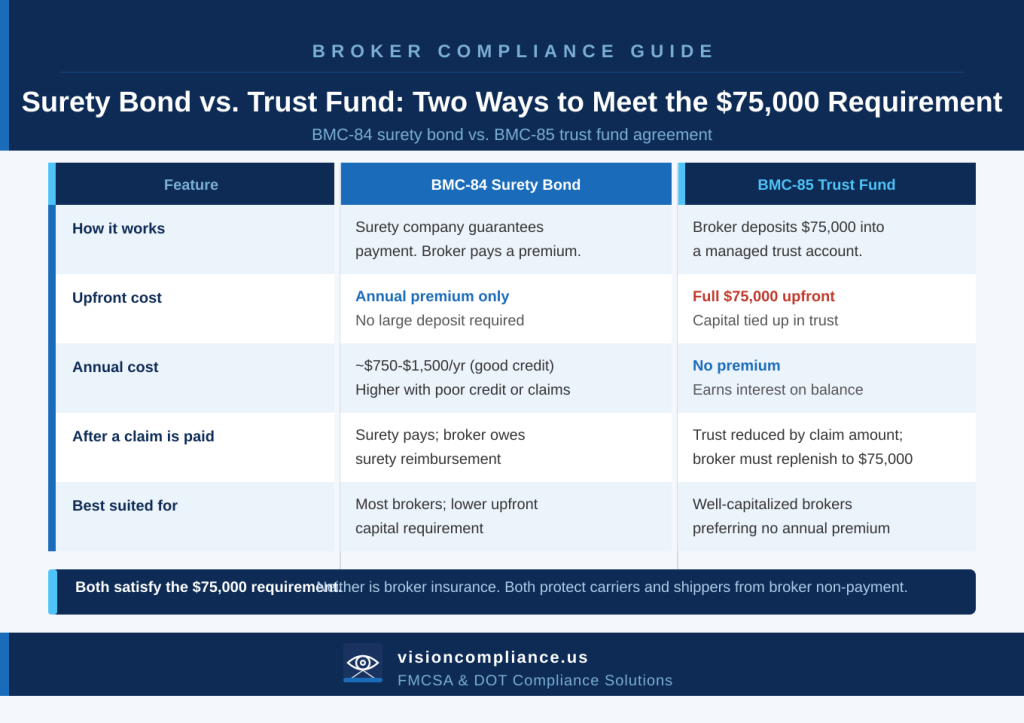
Brokers have two options for satisfying the financial security requirement: a surety bond filed on Form BMC-84, or a trust fund agreement filed on Form BMC-85. The two mechanisms differ significantly in how they work, who provides them, and what they cost.
| The bond is not the broker’s money A common misconception is that the surety bond sits in an account the broker controls. It does not. The bond is a guarantee by the surety company to pay valid claims up to $75,000. If a claim is paid, the surety company pays the claimant and then seeks reimbursement from the broker. The broker is ultimately responsible for every dollar paid out on a valid claim. |
What the Bond Covers
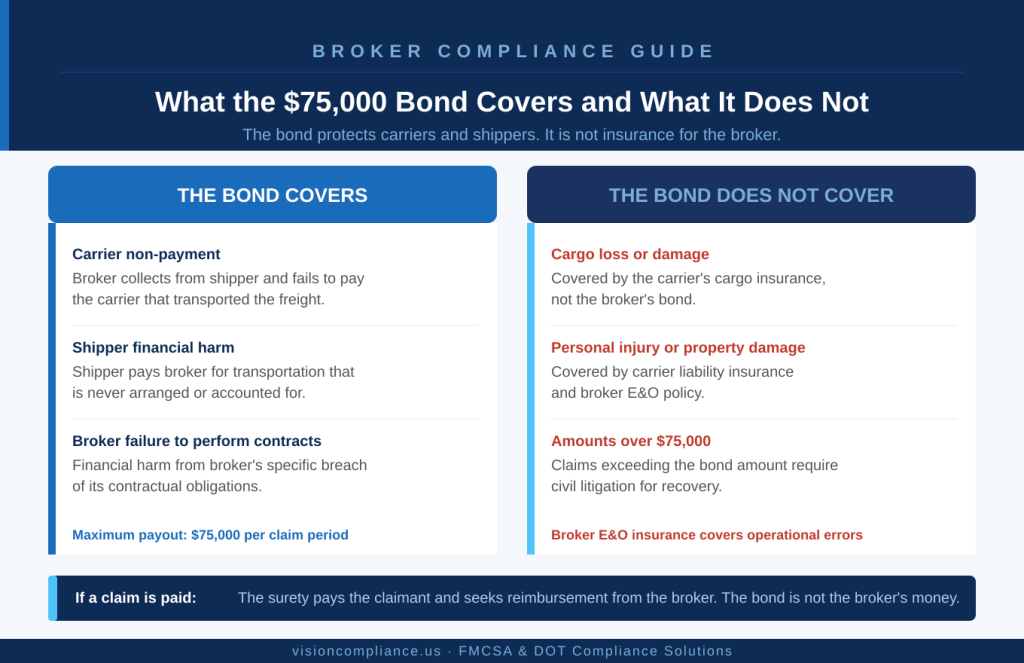
The bond covers financial harm suffered by shippers and motor carriers as a direct result of the broker’s failure to carry out its contracts. In practical terms, valid bond claims typically fall into two categories:
Carrier non-payment: A broker collects freight charges from a shipper and fails to pay the carrier that transported the freight. The carrier has delivered the load and is owed payment. If the broker fails to pay, the carrier can file a claim against the broker’s bond. This is the most common type of bond claim and the one that reflects the bond’s original purpose: protecting carriers from broker insolvency or fraud.
Shipper financial harm: A shipper pays a broker for transportation services and the broker fails to arrange the transportation or fails to account for the freight charges. The shipper can file a claim for the financial harm resulting from the broker’s failure to perform. Cargo loss or damage claims are generally not covered by the bond; those are covered by the carrier’s cargo insurance.
The bond does not cover every dispute a broker has with a shipper or carrier. It covers specific financial harm resulting from the broker’s failure to perform its contractual obligations. A shipper who is unhappy with service, or a carrier who disputes a freight charge, does not automatically have a valid bond claim. The claim must be grounded in a specific financial loss caused by the broker’s breach.
What the Bond Does Not Cover
Cargo loss or damage: The bond is not cargo insurance. A shipper whose freight is lost or damaged by a carrier has a claim against the carrier’s cargo insurance, not against the broker’s bond. Brokers who tell shippers their bond covers cargo loss are misstating what the bond does.
Personal injury or property damage: Accidents involving carriers hired by the broker are covered by the carrier’s liability insurance and potentially by the broker’s errors and omissions policy. The surety bond is not a liability policy.
Broker operational errors: Errors and omissions in the broker’s operations, such as booking the wrong carrier, providing incorrect transit instructions, or failing to communicate a pickup appointment, are covered by a professional liability or E&O policy if the broker carries one. The bond covers financial harm from non-payment and failure to perform, not operational errors.
Amounts over $75,000: The bond’s maximum exposure is $75,000 per claim period. If valid claims exceed this amount, claimants must look to other remedies including civil litigation. The bond does not provide unlimited coverage.
How Bond Claims Work
When a party believes they have a valid claim against a broker’s bond, the process works as follows:
- The claimant submits a written claim to the surety company that issued the bond, documenting the financial harm and the broker’s failure to pay or perform
- The surety investigates the claim, which typically includes contacting the broker for a response
- If the claim is valid, the surety pays the claimant up to the bond amount
- The surety then seeks reimbursement from the broker through its indemnification agreement
- If the broker cannot reimburse the surety, the surety may cancel the bond, triggering a lapse in the broker’s financial security filing and potential suspension of operating authority
The claims process is not instantaneous. Sureties investigate claims before paying. A broker who believes a claim is invalid has the opportunity to contest it. But a broker that is genuinely insolvent or has genuinely failed to pay carriers will find the surety paying valid claims and then pursuing the broker for reimbursement.
| When a bond claim is paid and the broker cannot reimburse the surety, the surety will typically cancel the bond. Bond cancellation requires the surety to provide the FMCSA with 30 days notice. During the notice period, the broker’s authority remains active. After cancellation, if no replacement bond is filed, the broker’s operating authority is suspended. A broker operating without an active bond filing is operating illegally. |
The Bond and Broker Creditworthiness
The cost of a surety bond is directly tied to the broker’s creditworthiness. Surety companies evaluate the broker’s financial history, credit score, business history, and claims history before setting the annual premium. A broker with strong financials and no claims history pays a lower premium. A broker with poor credit or prior bond claims pays significantly more.
Premium ranges: Brokers with excellent credit typically pay annual premiums in the range of 1 to 2 percent of the bond amount, or roughly $750 to $1,500 per year. Brokers with poor credit or prior claims may pay 3 to 5 percent or more, pushing the annual cost to $2,250 to $3,750 or higher. Some brokers with significant credit problems cannot obtain a standard surety bond at any price and must either work to improve their financial standing or use the trust fund alternative.
Claims history: A broker that has had claims paid against their bond is a higher-risk candidate for surety companies. Prior claims result in higher premiums, reduced bond limits, or outright denial from some sureties. Maintaining a clean claims history is not just operationally important; it has direct financial consequences for the cost of maintaining the bond.
What Brokers Can Do to Reduce Bond Claim Exposure
The bond is a safety net for the industry. Brokers who manage their operations well rarely face bond claims. The practices that reduce bond claim exposure are the same practices that support a healthy brokerage operation.
Pay carriers promptly: Most bond claims arise from broker non-payment to carriers. Maintaining disciplined accounts payable and paying carriers within the agreed terms eliminates the most common source of claims. When cash flow is tight, communicate proactively with carriers rather than going silent.
Collect from shippers before paying carriers: A broker that consistently pays carriers before collecting from shippers creates cash flow risk. When a shipper defaults or disputes a charge, the broker is left holding a liability they have already paid. Establishing clear credit terms with shippers and monitoring receivables reduces this exposure.
Written rate confirmations: Every load should have a signed rate confirmation before dispatch. A signed rate confirmation establishes the carrier’s agreed rate and reduces disputes over payment at delivery. A broker that relies on verbal agreements or unsigned confirmations has weaker documentation when carrier payment disputes arise.
Carrier vetting: A broker that vets carriers carefully is less likely to encounter carriers who perform poorly, generate cargo claims, or create disputes that escalate to bond claims. Carrier qualification is not just a negligent selection issue; it is a bond claim risk management issue.
Errors and omissions insurance: The surety bond covers non-payment and failure to perform. An E&O policy covers operational errors. Brokers who carry E&O insurance have broader protection against claims that do not fit the bond’s coverage scope. E&O is not required by the FMCSA but is increasingly required by shippers and is sound risk management practice.
The Bond and Operating Authority: What Brokers Must Monitor
The bond filing must remain continuously active. There are two ways the filing can lapse: the surety cancels the bond, or the broker fails to renew the bond before expiration.
Cancellation: If the surety cancels the bond due to non-payment of premium, insolvency concerns, or a valid claims situation it does not wish to continue backing, it must give the FMCSA 30 days written notice. During this period the broker should either cure the cancellation with the existing surety or obtain a replacement bond from a new surety and file it with the FMCSA before the cancellation takes effect.
Expiration: Bonds typically have an anniversary date. The surety renews the bond and issues a new premium invoice. If the broker fails to pay the renewal premium, the surety will cancel. Brokers should set calendar reminders 60 days before bond expiration to ensure renewal is processed and any replacement filing is in the FMCSA system before the existing bond expires.
The FMCSA SAFER system reflects the current bond filing status. Brokers should check their own SAFER profile periodically to confirm the bond shows as active. Shippers and carriers checking a broker’s authority status will see the bond status in SAFER; a lapsed bond is visible to everyone who checks.
