
Every new motor carrier must pass a federal safety audit within 18 months of receiving operating authority. Here’s exactly what auditors check, what a failure means, and how to build your operation to pass with confidence.
Starting a trucking company is one thing. Keeping it running past the first 18 months is another. The federal government has built a gate into that timeline that every new carrier must pass through.
The New Entrant Safety Audit is a mandatory compliance review conducted by the FMCSA within the first 18 months of a new carrier’s operating authority. It’s not optional. It’s not a courtesy visit. And failing it — or failing to have the right systems in place when the auditor arrives — can end a carrier’s interstate operations before they’ve fully begun.
This guide explains exactly what the New Entrant Safety Audit covers, how it’s conducted, what the auditor is looking for in each area, and the specific steps new carriers should take from day one to make sure they’re ready when the auditor knocks.
What Is the New Entrant Safety Audit?
Under 49 CFR Part 385, Subpart D, every new entrant motor carrier — a carrier that has received its USDOT operating authority and is operating under that authority for the first time — must undergo a safety audit conducted by the FMCSA or an authorized state agency within 18 months of beginning operations.
The audit is designed to verify that new carriers understand the federal safety regulations that apply to their operation and have the basic systems in place to operate safely and compliantly. Unlike a full compliance review, the New Entrant Safety Audit does not result in a safety rating. Instead, it produces one of two outcomes:
Pass: The carrier has demonstrated that it has the required safety management systems in place. The carrier continues operating and exits the new entrant program.
Fail: The carrier has not demonstrated adequate safety management. The FMCSA issues a notice of proposed safety order — and if the carrier cannot correct the deficiencies within 45 days, its operating authority is revoked.
This is not a bureaucratic formality. Carriers that fail the New Entrant Safety Audit and cannot remediate within 45 days lose their ability to operate in interstate commerce. The authority is revoked and must be reapplied for — a process that can take months and permanently marks the carrier’s record.
| When does the audit happen? The FMCSA schedules the audit at its discretion within the 18-month window. Carriers typically receive some advance notice, but the timing is not guaranteed. Some carriers are audited at 6 months; others at 16. The safest approach is to build compliance systems from day one — not in the weeks before the auditor calls. |
The Six Areas of the New Entrant Safety Audit
The New Entrant Safety Audit evaluates carriers across six safety fitness standard factors. These are the same six factors used in full compliance reviews — but the new entrant audit is somewhat narrower in scope, focusing on whether the carrier has the foundational systems in place rather than conducting an exhaustive examination of every record.
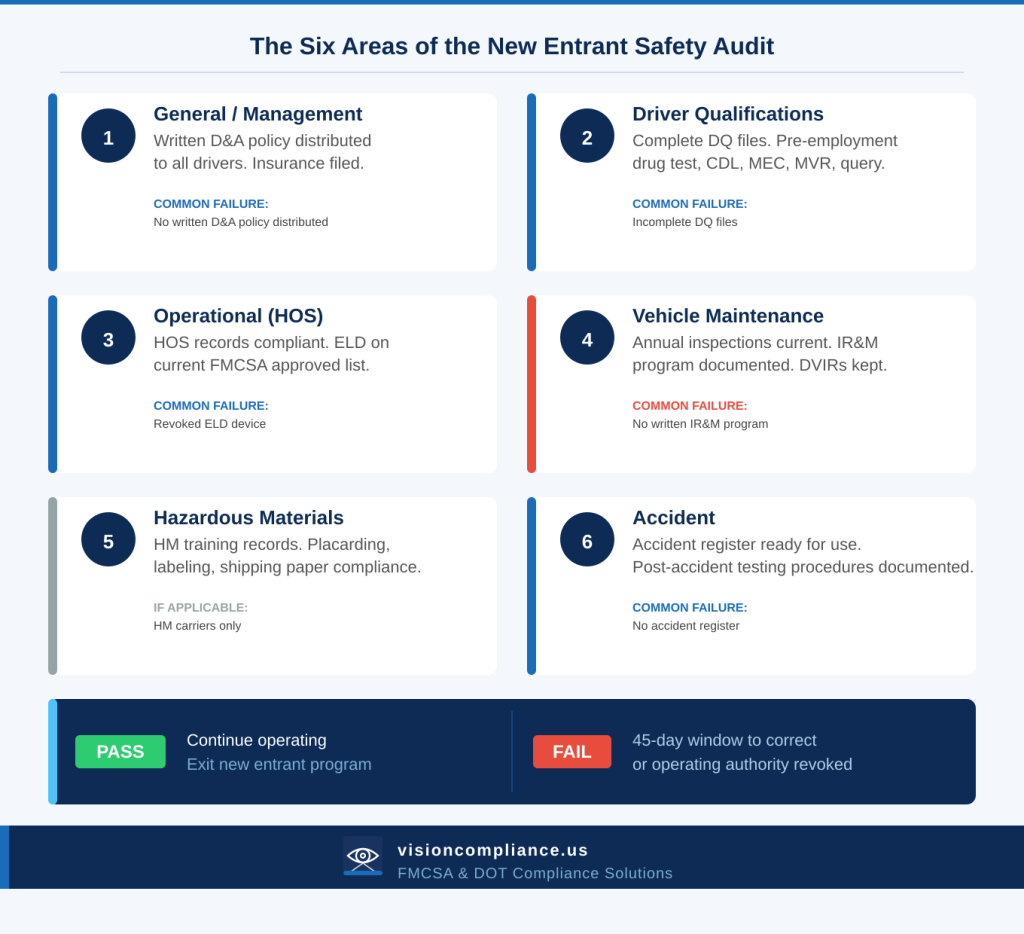
What Auditors Look For:
1. General: Drug and Alcohol Policy
The written drug and alcohol testing policy is the first thing many auditors ask for. It’s also one of the most common failure points for new carriers — not because they don’t have a testing program, but because they haven’t put it in writing and distributed it to their drivers.
The auditor will ask to see:
• The written drug and alcohol policy document
• Evidence that the policy was distributed to every driver before their first assignment
• Driver acknowledgment signatures confirming receipt
• Proof of enrollment in a DOT-compliant drug and alcohol testing consortium
• Pre-employment drug test results for every driver
• FMCSA Drug and Alcohol Clearinghouse query results for every driver
| Common failure New carriers often have a testing program but no written policy — or a written policy that was never formally distributed and acknowledged. The policy must exist in writing, must be distributed, and drivers must sign to confirm receipt before their first dispatch. |
2. Driver Qualifications
The Driver Qualification File is the most document-intensive area of the audit. The auditor will pull files for a sample of drivers and verify that each file contains all required elements.
A complete DQ file must include:
• Completed application for employment
• Motor vehicle record (MVR) from every state the driver held a license in the past 3 years
• Copy of current CDL with endorsements verified
• Valid Medical Examiner’s Certificate — not expired, issued by a registry-listed examiner
• Road test certificate or equivalent (e.g., copy of CDL if state-administered test used)
• Pre-employment drug test with verified negative result
• Prior employer inquiry results for the past 3 years
• FMCSA Drug and Alcohol Clearinghouse query result
• Annual review of driving record for each year of employment
For new carriers, the annual review requirement applies after the first year of the driver’s employment. But all other elements must be in place from day one.
3. Operational: Hours of Service
The auditor will review a sample of driver logs — ELD records or paper logs if ELD is not required — to verify that drivers are complying with federal HOS requirements. They will also verify that the carrier is using an FMCSA-approved ELD.
Key HOS compliance points for new carriers:
• 11-hour driving limit in a 14-hour on-duty window
• 10 consecutive hours off duty required before the next on-duty period
• 30-minute break required after 8 hours of driving
• 60/70-hour limit over 7/8 consecutive days
• ELD device must be on FMCSA’s current approved device list — not revoked
| ELD tip: Verify your ELD device is on the FMCSA’s approved device list before you dispatch your first load — and check again quarterly. The FMCSA has revoked over 20 ELD models in 2026 alone. A revoked device results in an OOS violation at any roadside inspection and will be flagged during a new entrant audit. |
4. Vehicle Maintenance
Every vehicle in the fleet must have:
• A current annual inspection (within the past 12 months), conducted by a qualified inspector
• A systematic inspection, repair, and maintenance (IR&M) program — documented in writing
• Driver Vehicle Inspection Reports (DVIRs) completed for every trip, retained for 90 days
• Defect sign-off documentation for any defect noted in a DVIR before the vehicle returned to service
For new carriers, the most common maintenance failure is the absence of a documented IR&M program. The program doesn’t need to be elaborate — but it must exist in writing, cover every vehicle in the fleet, and be followed consistently.
5. Hazardous Materials (if applicable)
If the carrier transports hazardous materials in quantities requiring placarding, the auditor will also review:
• HM training and testing records for all drivers who transport HM
• Proper shipping papers, placarding, and labeling practices
• Security plan (if required for the type and quantity of HM transported)
• HM registration with PHMSA (if required)
Carriers that do not transport placardable quantities of hazardous materials are not evaluated in this area.
6. Accident Register
The accident register is a simple but mandatory record. Every carrier must maintain a register of all accidents involving a CMV that resulted in a fatality, injury requiring immediate medical treatment away from the scene, or a vehicle being towed from the scene.
For new carriers without accidents, the auditor will verify that the accident register exists and is ready for use — and that the carrier has a documented post-accident testing procedure so that if an accident occurs, the carrier knows exactly what to do within the 8-hour alcohol and 32-hour drug testing windows.
The 45-Day Remediation Window
If a carrier fails the New Entrant Safety Audit, the FMCSA issues a notice of proposed safety order — essentially a warning that the carrier’s operating authority will be revoked if the deficiencies are not corrected.
The carrier then has 45 days to:
• Correct all identified deficiencies
• Submit documentation to the FMCSA demonstrating that the deficiencies have been addressed
• Request a re-evaluation if appropriate
If the carrier successfully demonstrates correction within 45 days, the proposed safety order is withdrawn and the carrier continues operating. If the carrier fails to correct the deficiencies or does not respond, the operating authority is revoked.
Forty-five days sounds like enough time. For a carrier that has never built compliance systems before, it often isn’t. Building a DQ file system, implementing a drug and alcohol testing program, establishing a maintenance program, and generating the documentation to prove all of it — in 45 days, while running a trucking operation — is extremely difficult.
This is why compliance from day one is not optional. It’s the only strategy that reliably works.
| After the audit Passing the New Entrant Safety Audit does not mean compliance work is done. It means the carrier has exited the new entrant program and entered the standard FMCSA monitoring environment. SMS scores continue to accumulate, ELD devices continue to be reviewed, and a compliance review can be triggered at any time by a high SMS score, a serious crash, or a complaint. |
A New Carrier Compliance Timeline
The following timeline outlines the key compliance actions a new carrier should complete from the moment they receive operating authority:
Day 1 — Operating authority received: Enroll in a DOT-compliant drug and alcohol testing consortium. Verify ELD device is on the FMCSA approved list. Confirm operating insurance is filed with FMCSA and BOC-3 is current.
Before first driver dispatch: Complete pre-employment drug test and receive verified negative result. Complete FMCSA Clearinghouse query. Gather prior employer drug/alcohol records (past 3 years). Open Driver Qualification File with all required documents. Distribute written drug and alcohol policy and obtain signed acknowledgment.
Before first vehicle dispatch: Verify annual inspection is current for every vehicle. Establish documented inspection, repair, and maintenance program. Confirm DVIR process is in place and understood by all drivers.
Ongoing — Monthly: Monitor SMS score in FMCSA portal. Track MEC expiration dates. Confirm random testing selection is being managed by consortium. Review ELD compliance for any patterns.
Month 12 — Annual review: Complete annual MVR review for every driver. Verify annual vehicle inspections are current. Confirm random testing rates met minimums. Complete annual Clearinghouse query for every driver.
Month 18 — Audit window closes: New Entrant Safety Audit must have been completed by this point. If not yet scheduled, contact FMCSA to confirm status.
In a Nutshell