
Getting your own operating authority is a major milestone and the beginning of a set of federal compliance obligations that didn’t apply when you were running under someone else’s authority. This guide covers everything that changes on day one and what you need to have in place before your first load moves.
Running under a carrier’s authority and running your own authority are fundamentally different compliance situations. When you operate under someone else’s MC number, that carrier is responsible for the compliance program: the drug and alcohol testing, the driver qualification files, the vehicle maintenance records, and the insurance. You follow their system.
When you get your own authority, all of that becomes your responsibility. The FMCSA doesn’t care that you’ve been driving for fifteen years. The moment your operating authority is active, you are a motor carrier, and motor carriers have specific, documented, federally mandated compliance obligations that begin immediately.
Many owner-operators who obtain their own authority significantly underestimate what that means. They focus on getting the authority, the insurance, and the first load, and discover the compliance requirements reactively, often during a roadside inspection or a new entrant safety audit that goes badly. This guide is designed to prevent that.
What Actually Changes When You Get Your Own Authority
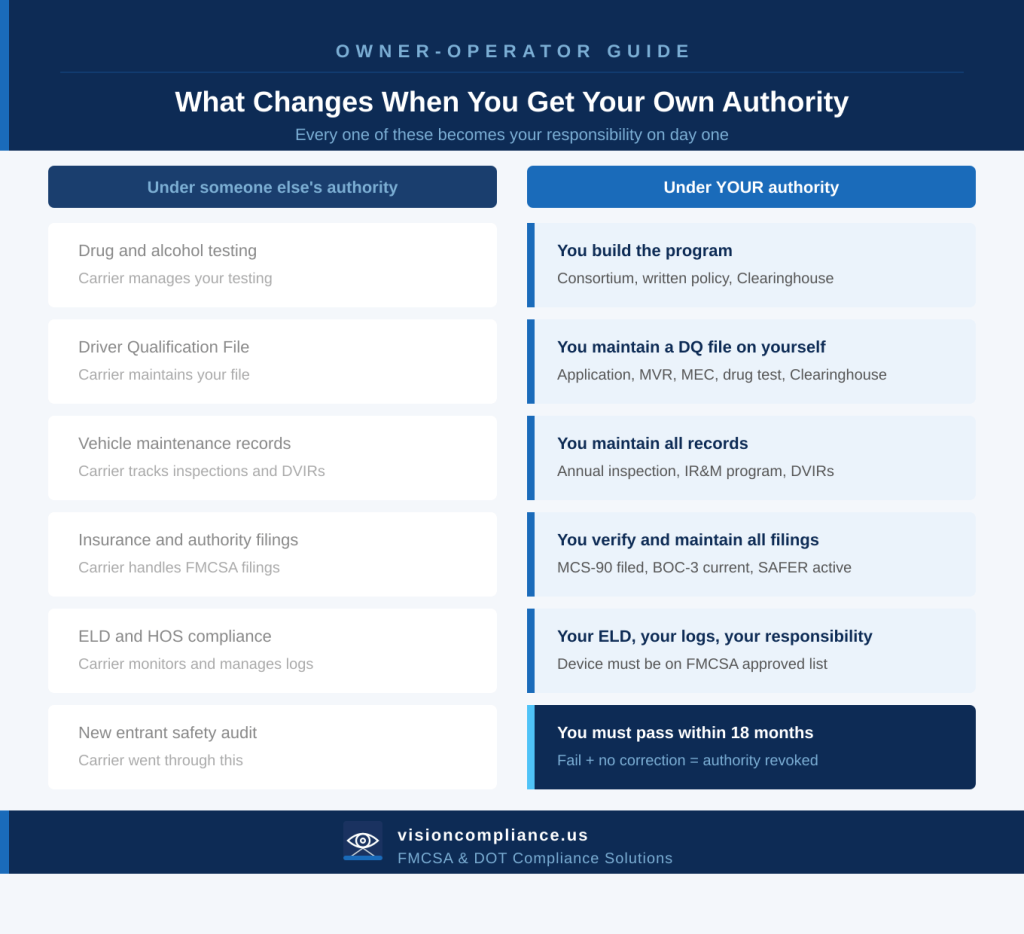
Before your own authority, as a company driver or a leased owner-operator under a carrier’s authority, the carrier was responsible for:
- Your drug and alcohol testing program
- Your Driver Qualification File
- Vehicle maintenance records and annual inspections
- Insurance filings with the FMCSA
- ELD compliance and HOS monitoring
- Accident register and post-accident testing procedures
When you get your own authority, every one of these becomes your obligation. You are now the carrier. The FMCSA will hold your MC number — not anyone else’s — responsible for compliance with Parts 382, 390, 391, 392, 393, 395, and 396 of the Federal Motor Carrier Safety Regulations.
The new entrant program: Every new motor carrier enters a mandatory 18-month new entrant monitoring period. During this period, the FMCSA will conduct a New Entrant Safety Audit — an in-person review of your compliance systems. Carriers that fail the audit and cannot correct the deficiencies within 45 days have their operating authority revoked. The audit evaluates the same compliance systems you need to build from day one.
| The most common mistake New owner-operators often believe that having a CDL, passing the DOT physical, and registering with the FMCSA is sufficient. It is not. Registration gets you the authority number. Compliance builds the systems that allow you to keep it. |
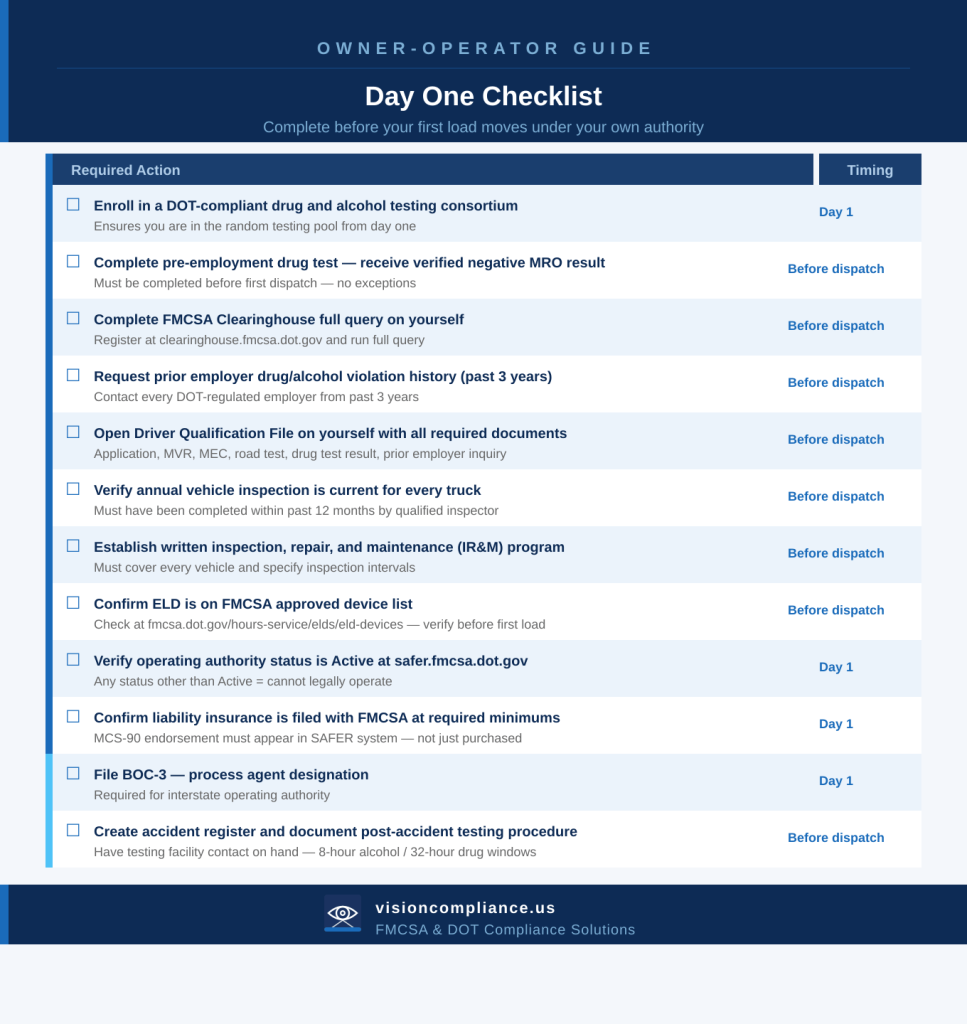
Day One Checklist: What Must Be in Place Before First Dispatch
Your Driver Qualification File, for Yourself
One of the most commonly overlooked requirements for new owner-operators is that you need a Driver Qualification File on yourself. The DQ file requirement under 49 CFR Part 391 applies to every driver who operates a CMV under your authority, including you.
Your DQ file must include:
- Completed application for employment, even if you are the owner and sole driver
- Motor vehicle record from every state you have held a license in the past 3 years
- Valid, current Medical Examiner’s Certificate issued by an FMCSA National Registry examiner
- Pre-employment drug test with verified negative result. It must be completed before the first dispatch
- FMCSA Drug and Alcohol Clearinghouse full query result
- Prior employer drug/alcohol inquiry for any DOT-regulated employment in the past 3 years
- Road test certificate or copy of CDL
Many new owner-operators find the employment application requirement confusing: why do you need to apply for a job with yourself? The regulation doesn’t distinguish between employed drivers and owner-operators. The file must exist, must be complete, and must be maintained and updated annually.
| Annual requirements: Once your DQ file is established, certain documents must be updated annually: your motor vehicle record review, your certificate of violations, and your FMCSA Clearinghouse limited query. These are not one-time requirements. Set calendar reminders for each, tied to your authority start date. |
Drug and Alcohol Testing: Building Your Own Program
When you operated under a carrier’s authority, they managed your drug and alcohol testing. Now you are responsible for your own testing program under 49 CFR Part 382.
Consortium enrollment: Most owner-operators join a C/TPA (Consortium/Third-Party Administrator) rather than managing their own program. A consortium pools multiple small operators together for random testing purposes, ensuring that even a single-driver operation meets the random testing rate requirements, currently 50% of the average driver count for drugs and 10% for alcohol.
Pre-employment testing: Before you dispatch your first load under your own authority, you must complete a pre-employment drug test and receive a verified negative result. This applies even if you were recently tested under a previous employer’s program. The test is tied to the authority, not the person’s recent history.
Clearinghouse registration: Every CDL driver, including owner-operators, must be registered in the FMCSA Drug and Alcohol Clearinghouse. You must complete a full Clearinghouse query on yourself before your first dispatch, and a limited query annually. You must also report any violations to the Clearinghouse.
Written policy: You must have a written drug and alcohol testing policy and must have distributed it to every driver covered by your authority, including yourself. The policy must meet the requirements of 49 CFR Part 382 and must be signed and acknowledged before first dispatch.
Vehicle Maintenance: The Requirements Are Yours Now
Under a carrier’s authority, the carrier maintained the vehicle records. Under your own authority, you are responsible for:
Annual inspections: Every vehicle in your fleet must have a current annual inspection — completed within the past 12 months by a qualified inspector. The inspection must be on file. A vehicle without a current annual inspection sticker will be placed out of service at any roadside inspection.
Written IR&M program: You must have a written systematic inspection, repair, and maintenance program covering every vehicle you operate. The program must specify the intervals and procedures for inspection and maintenance. It does not need to be elaborate, but it must exist in writing and be followed consistently.
Driver Vehicle Inspection Reports (DVIRs): You must complete a DVIR for every trip — pre-trip and post-trip. Any defect noted must be signed off by a qualified mechanic before the vehicle returns to service. DVIRs must be retained for 90 days.
ELD compliance: If you are required to use an ELD (which applies to most owner-operators in interstate commerce), your device must be on the FMCSA’s current approved device list. Verify this before first dispatch and check quarterly — the FMCSA has revoked multiple ELD models in recent years.
Insurance: Understanding Your Requirements
As a motor carrier with your own authority, you must maintain minimum liability insurance filed with the FMCSA. The minimums depend on your operation:
- General freight (non-hazmat, vehicles under 10,001 lbs): $300,000
- General freight (non-hazmat, vehicles over 10,001 lbs): $750,000
- Hazardous materials: $1,000,000 to $5,000,000 depending on commodity
Insurance must be filed directly with the FMCSA, not just purchased. Your insurer files the MCS-90 endorsement with the FMCSA, which appears in the SAFER system. Verify that your insurance filing is reflected in the SAFER system after your policy is issued. A policy that hasn’t been filed is not compliant.
Cargo insurance: Liability insurance covers third-party bodily injury and property damage. It does not cover your cargo. If you are hauling freight for brokers or shippers who require cargo insurance — which most do — you will need a separate cargo policy, typically with a minimum of $100,000 in coverage.
The New Entrant Safety Audit: Your 18-Month Gate
Every new motor carrier must pass a New Entrant Safety Audit within 18 months of receiving operating authority. The audit is conducted by the FMCSA or an authorized state agency and evaluates six areas: general/management (including your drug and alcohol program), driver qualifications, operational compliance (HOS), vehicle maintenance, hazardous materials (if applicable), and accident records.
The audit is not a surprise inspection. It is a scheduled review — though the exact timing within the 18-month window is at the FMCSA’s discretion. Some carriers are audited at 6 months; others at 16. The safest approach is to treat every day as if the auditor could call tomorrow.
Pass: The carrier exits the new entrant program and enters standard FMCSA monitoring.
Fail: The carrier has 45 days to correct identified deficiencies and submit documentation. Carriers that cannot correct within 45 days have their operating authority revoked.
The compliance systems described throughout this guide: DQ file, drug and alcohol program, maintenance records, ELD compliance, and accident register are exactly what the auditor will examine. Building them correctly from day one is the only reliable strategy for passing.
Operating Under a Broker’s Load vs. Your Own Customers
Most new owner-operators start by hauling freight arranged by freight brokers. This is straightforward from an authority standpoint — the broker arranges the load, you haul it under your own MC number. But there are compliance implications worth understanding.
Broker vetting: Brokers will vet your authority before tendering loads. They will check your operating authority status, your insurance, and your SMS score in the FMCSA system. A carrier with alert status in the Unsafe Driving or Vehicle Maintenance BASIC will have difficulty getting loads from quality brokers.
Rate confirmation agreements: When you accept a load from a broker, you are entering a contract. The rate confirmation specifies the rate, the origin and destination, the commodity, and the terms. Read it carefully. Some rate confirmations include compliance requirements: cargo insurance minimums, proof of authority, prohibited re-brokering clauses.
Double brokering: If a broker gives you a load and you hand it to another carrier without the broker’s knowledge and consent, that is double brokering. It is both a federal violation and a serious commercial problem. Under your own authority, you are responsible for ensuring the freight moves on your equipment or under a proper trip lease.
| SMS scores start accumulating immediately The moment your authority is active, every roadside inspection, every out-of-service violation, and any crash data begins building your SMS score. A new carrier with a clean record has no SMS history, which is a neutral starting position. Two or three bad inspections in the first six months can put a new carrier in alert status before they’ve completed their first year of operation. Invest in pre-trip inspections, ELD compliance, and driver fitness from the first day. |