

When a commercial vehicle is involved in an accident, the clock starts immediately. Carriers that don’t know their obligations, and haven’t prepared for them, risk missing mandatory testing windows, creating documentation gaps, and turning a recoverable situation into a serious regulatory and legal problem.
No carrier plans for an accident. But every carrier operating commercial motor vehicles needs a documented post-accident procedure because the regulatory obligations that begin the moment a qualifying accident occurs are time-sensitive, specific, and unforgiving.
Under 49 CFR Parts 382 and 390, motor carriers have mandatory obligations following any accident involving a commercial motor vehicle. The most time-critical of these is post-accident drug and alcohol testing, with a two-hour preferred window, an 8-hour hard cutoff for alcohol testing, and a 32-hour hard cutoff for drug testing. Miss these windows without documented reasonable efforts, and the carrier faces a deemed positive — the regulatory equivalent of a failed test.
This guide covers every post-accident obligation a carrier has, the specific time windows that govern each, and what a defensible post-accident procedure looks like in practice.
What Triggers Post-Accident Testing?
Not every accident involving a commercial motor vehicle triggers the federal post-accident testing requirement. Under 49 CFR Part 382.303, post-accident testing is required when an accident involving a commercial motor vehicle operating on a public road and results in any of the following:
• A human fatality
• A bodily injury to any person who, as a result of the injury, immediately receives medical treatment away from the scene of the accident
• Disabling damage to any motor vehicle requiring the vehicle to be transported away from the scene by a tow truck or other motor vehicle
The testing requirement applies to the driver who was operating the CMV at the time of the accident. It applies regardless of fault — the driver does not need to be cited or determined responsible for the accident to be subject to post-accident testing.
Exceptions: A driver is not required to submit to post-accident testing if the driver was operating a legally parked vehicle, or if the accident involved only property damage and no bodily injury or fatality.
| Why this matters beyond compliance Post-accident testing results become critical evidence in litigation. A negative test result is one of the most effective defenses a carrier can have in a personal injury or wrongful death lawsuit following a truck accident. A missed testing window — even if the driver was not impaired — creates a gap that plaintiff attorneys will exploit. The absence of a test is not the same as a negative result. |
The Testing Windows: What the Clock Looks Like
The federal regulations establish specific time windows for post-accident testing. These windows are not flexible. Missing them without documented reasonable efforts constitutes a violation.
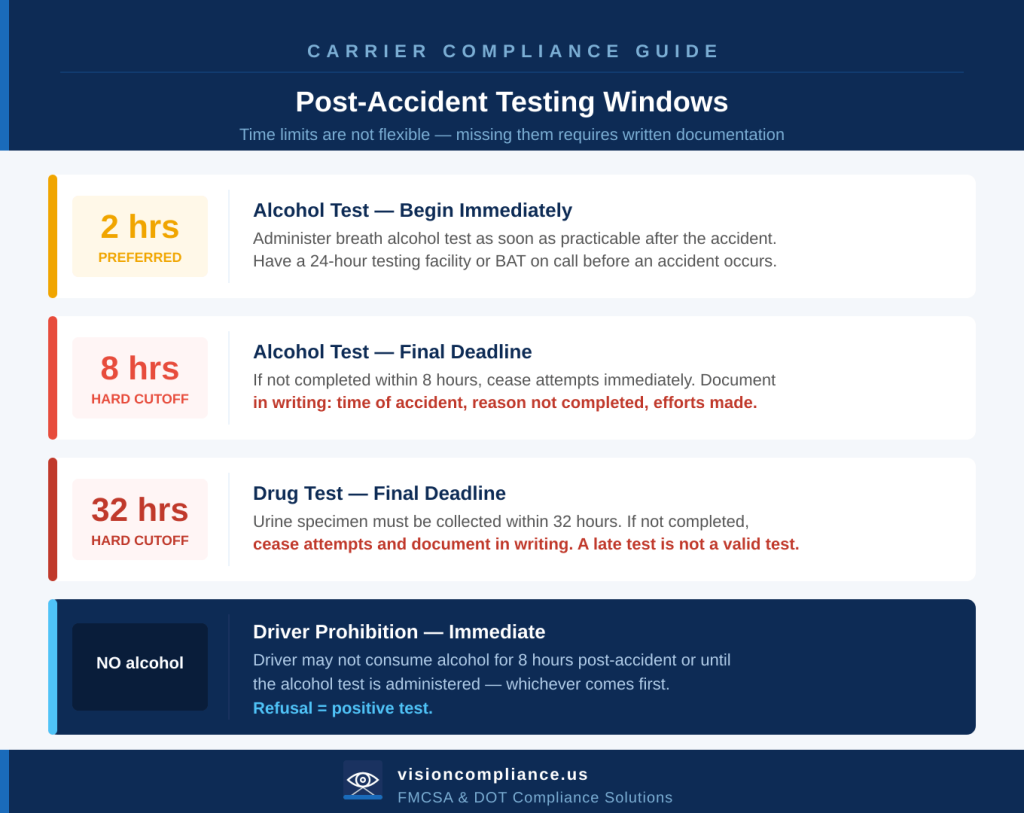
If a test cannot be completed within the required window, the carrier must document the reasonable efforts made to complete the test and the reason it was not completed. This documentation is not optional. It is the carrier’s evidence that the missed window was not due to negligence or avoidance.
Step-by-Step: What to Do Immediately After a Qualifying Accident

Step 1: Ensure Safety and Notify Authorities
The first priority after any accident is the safety of everyone involved. Ensure emergency services have been called. Do not move the vehicle unless necessary for safety or directed by law enforcement. The driver should cooperate fully with responding officers.
As soon as the immediate safety situation is addressed, the driver or dispatch must determine whether the accident meets the regulatory threshold for post-accident testing. If there is any doubt, treat it as a qualifying accident and initiate the testing process. It is always better to complete a test that turns out to be unnecessary than to miss one that was required.
Step 2: Contact Dispatch or Compliance Immediately
The driver must contact the carrier’s designated contact — whether that is dispatch, a safety director, or a compliance officer — as soon as safely possible after the accident. This contact initiates the carrier’s response protocol.
The carrier’s representative must begin the testing process immediately. Every minute that passes narrows the 8-hour alcohol testing window. Do not wait for a full accident report, a police determination of fault, or insurance notification before beginning the testing process. Testing comes first.
Step 3: Initiate Alcohol Testing Within 2 Hours
The carrier must arrange for a breath alcohol test to be administered as soon as practicable, with the goal of completing it within 2 hours. Options include:
• Sending the driver to the nearest collection site that can perform a breath alcohol test
• Dispatching a breath alcohol technician (BAT) to the accident scene or a nearby location
• Using a consortium or third-party administrator (TPA) that maintains 24-hour testing availability
The carrier should have the contact information for a 24-hour testing facility or on-call BAT readily available before an accident occurs. Looking up testing options in the aftermath of an accident costs time that cannot be recovered.
| Pre-accident preparation Every carrier should have a post-accident kit available to dispatch personnel and drivers. At minimum: the phone number of the 24-hour testing facility or TPA, the carrier’s DER contact information, a brief written summary of what triggers testing and what the time windows are, and the post-accident documentation form. Carriers that have never located a 24-hour testing facility before an accident will spend the first hour of the 8-hour window finding one. |
Step 4: Initiate Drug Testing Within 32 Hours
A urine specimen must be collected within 32 hours of the accident. This is typically less time-pressured than the alcohol test, but it requires the same advance preparation — knowing where the driver can go for collection at any hour of the day.
The driver must not be allowed to avoid or delay the collection process. If the driver claims injury prevents collection, medical clearance should be obtained and documented. The carrier should be in communication with the driver throughout to ensure the collection occurs within the window.
Step 5: Preserve the Scene and Document Everything
While the testing process is initiated, the carrier should also begin collecting information and documentation from the accident scene. This documentation serves both regulatory and legal purposes.
Documentation to collect:
• Driver’s name, license number, and CDL endorsements
• Vehicle identification — unit number, VIN, license plate
• Location, date, and time of the accident
• Names and contact information of any witnesses
• Law enforcement agency and report number
• Names and contact information of other drivers and injured parties
• Photographs of the scene, vehicles, and any visible damage
• ELD or paper log records for the driver’s duty status leading up to the accident
Step 6: Complete the Accident Register Entry
Every qualifying accident must be recorded in the carrier’s accident register within 24 hours. The accident register is a required document under 49 CFR Part 390.15 and must contain:
• Date of accident
• City or town and state where the accident occurred
• Driver’s name
• Number of injuries
• Number of fatalities
• Whether hazardous materials were released
The accident register must be retained for 3 years and must be made available to the FMCSA or authorized enforcement personnel upon request.
Step 7: Document Missed Windows
If the alcohol test is not completed within 8 hours, or the drug test is not completed within 32 hours, the carrier must immediately cease attempts and document the situation in writing. The documentation must describe:
• The time of the accident
• The time testing was initiated
• The specific reasons why the test was not completed within the required window
• The efforts made to complete the test
This documentation must be retained in the driver’s drug and alcohol testing file. It is the carrier’s evidence that the missed window resulted from circumstances beyond the carrier’s control — not from avoidance or negligence.
| A missed testing window without documentation is treated as a failure to test. The regulatory consequences include a violation in the drug and alcohol BASIC, which affects the carrier’s SMS score. In litigation, an undocumented missed window is particularly damaging. It suggests the carrier made no effort to complete the test. |
What the Driver Must Not Do After a Qualifying Accident
The regulations place specific prohibitions on the driver following a qualifying accident. Violations of these prohibitions by the driver do not eliminate the carrier’s obligation, but they create additional complications.
No alcohol for 8 hours: The driver may not consume alcohol for 8 hours following the accident or until the post-accident alcohol test has been administered, whichever comes first. A driver who consumes alcohol before the test — even after the accident and before the 8-hour window closes — has effectively contaminated any subsequent test result.
Remain available: The driver must remain available for testing and may not leave the scene or the area without authorization. A driver who leaves the scene or becomes unreachable after a qualifying accident creates a documentation and compliance problem for the carrier.
No refusal: Refusal to submit to post-accident testing is treated identically to a positive test result. A refusal triggers all the same return-to-duty requirements as a positive, requires the driver to complete the SAP process before returning to safety-sensitive functions, and must be reported to the FMCSA Drug and Alcohol Clearinghouse.
Building a Post-Accident Response Program
The carriers that handle post-accident situations most effectively are those that have built a response program before an accident occurs. A documented post-accident program should include:
Written procedure: A step-by-step written procedure that dispatchers, safety personnel, and drivers can follow in the aftermath of a qualifying accident. The procedure should specify who to call, in what order, and what the time windows are.
24-hour testing access: Contact information for a testing facility or TPA that can provide alcohol and drug testing at any hour. This should be identified before an accident occurs and verified to be operational 24 hours a day, 7 days a week.
Driver training: Every driver should understand, before they dispatch their first load, what post-accident testing is, what triggers it, what the time windows are, and what they are prohibited from doing after a qualifying accident. This training should be documented.
Post-accident documentation form: A standardized form that captures all required information from the accident scene. This form should be available to drivers and dispatch — not something that has to be created from scratch in the aftermath of an accident.
Accident register: A maintained accident register ready to receive entries. Every qualifying accident must be logged within 24 hours. A carrier that has not established an accident register before an accident occurs is already in violation.
