
Carrier vetting does not have to be slow to be thorough. This guide walks through a repeatable, documented vetting process that covers every essential check in a structured sequence, produces a timestamped record for each carrier, and takes less than ten minutes per new carrier.
The most common carrier vetting problem is not that brokers fail to check carriers. Most brokers check something. The problem is that what they check is inconsistent, the results are not documented, and the process differs from person to person and load to load. When a carrier involved in an accident turns out to have had alert-level SMS scores or a lapsed insurance filing at the time of assignment, the question is not just whether the broker checked. The question is whether the broker can prove what they checked, when they checked it, and what the results were.
A documented, consistent vetting process solves this problem. It takes no longer than an undocumented one. It produces a timestamped record that demonstrates reasonable care. And it catches disqualifying issues early, before a load is assigned to a carrier that should not have received it.
This guide presents a step-by-step carrier vetting process structured around the tools that are already available to every freight broker: the FMCSA SAFER system, the SMS portal, and the carrier’s certificate of insurance. No paid subscription is required for the core checks.
Before You Start: What You Need
Every check in this process can be completed using free, publicly available government tools. Before you begin, have the following ready:
- The carrier’s USDOT number or MC number (collected from the carrier at outreach or load board contact)
- A browser tab open to safer.fmcsa.dot.gov
- A browser tab open to ai.fmcsa.dot.gov/SMS
- A copy of the carrier’s current certificate of insurance
- Your carrier file or TMS where you will record the results The entire process should take 7 to 10 minutes for a carrier you have not worked with before. For a carrier on your approved list who is being re-verified, it takes less. The investment is minimal. The documentation it produces is significant.
Operating Authority
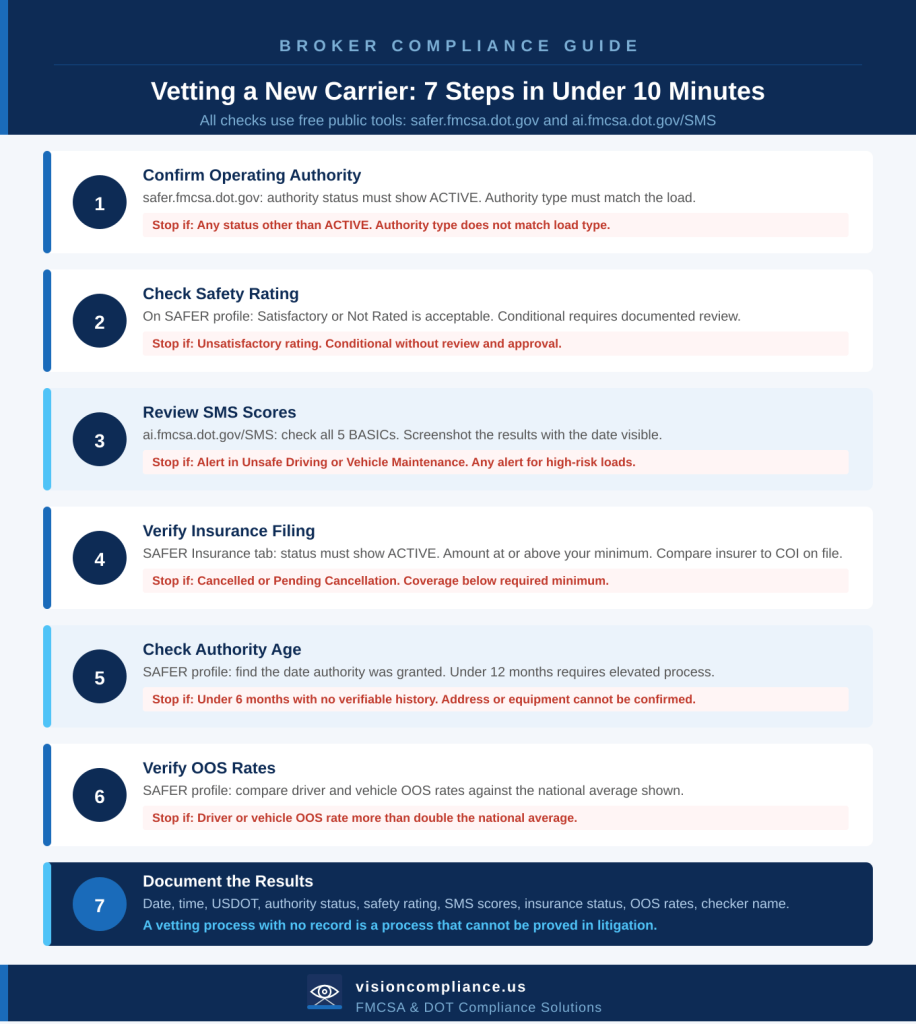
The SAFER system at safer.fmcsa.dot.gov is the authoritative source for carrier authority status. A carrier whose authority shows anything other than ACTIVE cannot legally operate as a for-hire motor carrier. Common non-active statuses include:
Inactive: The carrier’s authority has been deactivated, either voluntarily or by the FMCSA. The carrier cannot legally transport regulated commodities.
Revoked: The carrier’s authority has been permanently withdrawn. This may be due to a failed safety audit, insurance lapse, or other regulatory violation.
Suspended: The carrier’s authority has been temporarily suspended. Common reasons include lapsed insurance filing or failure to pay FMCSA fees.
A broker that assigns a load to a carrier with non-active authority has assigned freight to an entity that is not legally authorized to transport it. This creates direct liability exposure regardless of what the carrier told the broker about their status.
| Verify, do not trust Carriers occasionally tell brokers their authority is active when it is not. The carrier may not know their authority has lapsed, or they may know and be concealing it. Either way, the broker’s obligation is to verify in the SAFER system, not to accept the carrier’s representation. A SAFER screenshot taken at the time of assignment is the proof that matters. |
Reading SMS Scores
The SMS system scores carriers in five BASICs: Unsafe Driving, Hours of Service Compliance, Driver Fitness, Controlled Substances and Alcohol, and Vehicle Maintenance. Each BASIC is scored on a percentile basis comparing the carrier against other carriers with similar numbers of inspections. A higher percentile means the carrier has proportionally more violations in that category than most carriers.
Alert status: A carrier reaches alert status when their BASIC score exceeds the intervention threshold for that category. Alert status signals that the FMCSA has identified this carrier as having a safety problem that may warrant intervention. A broker who assigns a load to a carrier with alert status in Unsafe Driving or Vehicle Maintenance has assigned freight to a carrier that the FMCSA has already flagged as a safety concern.
Insufficient data: A carrier with very few inspections may show insufficient data rather than a score. This is not the same as a clean record. A carrier with no inspection history may have simply not been inspected yet. New carriers with authority under 12 months frequently show insufficient data across all BASICs. Apply heightened scrutiny to these carriers.
What to document: Take a screenshot of the SMS results page showing the carrier’s USDOT number, the date, and the score or alert status for each BASIC. Save it to the carrier file. A screenshot taken at the time of assignment demonstrates that you checked the carrier’s safety data at the time you made the assignment decision.
Insurance Verification
Checking that a carrier has insurance is not the same as verifying that the insurance is currently filed and active with the FMCSA. The SAFER system’s Insurance tab shows the current filing status for every insurer that has filed a form for the carrier. This is the authoritative verification.
A certificate of insurance from the carrier is a secondary tool. It shows the policy details as of the date the certificate was issued. It does not show whether the policy was subsequently cancelled. A carrier can present a certificate for a policy that lapsed six weeks ago. The SAFER system will show the actual current filing status.
What to look for: The filing status should show ACTIVE. The coverage type should be liability, with a dollar amount at or above your minimum standard for the load being assigned. For general freight, the federal minimum is $750,000. Note the insurer name and compare it against the certificate on file. A mismatch between the insurer on the SAFER filing and the insurer on the certificate suggests the policy may have changed.
Pending cancellation: If the SAFER insurance tab shows a status of Pending Cancellation, the carrier’s insurer has notified the FMCSA that the policy is being cancelled. The carrier is operating on borrowed time. Do not assign a load to a carrier with pending cancellation status. The coverage may lapse before the freight is delivered.
New Carrier Risk
Carriers with recently issued authority represent a higher risk profile for several reasons. They have no operating history that can be evaluated. They may not have established the compliance systems that more experienced carriers have in place. And they are the profile most commonly used in double brokering and cargo theft schemes, where bad actors obtain new authority specifically to accept loads they intend to divert.
This does not mean new carriers should never receive loads. It means new carriers warrant additional verification steps before the first load is assigned:
- Call the carrier’s dispatch line using a number listed in the SAFER system or verified independently, not a number the carrier provided
- Confirm the carrier has the specific equipment type available for the load
- Verify the carrier’s physical address against the SAFER profile
- Ask the carrier for references from other brokers they have worked with recently
- For the first load, consider requiring GPS tracking and calling the shipper at pickup to confirm the driver’s identity matches the assignment
Documenting the Check: What the Record Should Show
The documentation produced by each carrier vetting check is the evidence of your due diligence. For every new carrier vetting, the record should include:
- The date and time the checks were performed
- The carrier’s USDOT number and MC number
- The authority status at time of check (ACTIVE or other)
- The safety rating at time of check
- The SMS BASIC scores or alert status at time of check
- The insurance filing status at time of check
- The authority issuance date
- The OOS rates for driver and vehicle inspections
- The name of the person who performed the check
This record should be created at the time of the check, not reconstructed after the fact. A record created after an incident, based on memory or after-the-fact retrieval, has significantly less evidentiary value than a contemporaneous record created at the time of the vetting decision.
Retention: Carrier vetting records should be retained for a minimum of three years from the date of the most recent load assignment to that carrier. In the event of litigation arising from an accident, documentation from the time of the assignment is the most important evidence the broker can produce.
| A carrier vetting process that is not documented is a process that cannot be proved. In a negligent selection case, the broker must demonstrate that they exercised reasonable care in selecting the carrier. A broker who checked the right things but kept no records is in nearly the same position as a broker who checked nothing. The documentation is not a formality. It is the evidence. |
When to Apply Elevated Scrutiny
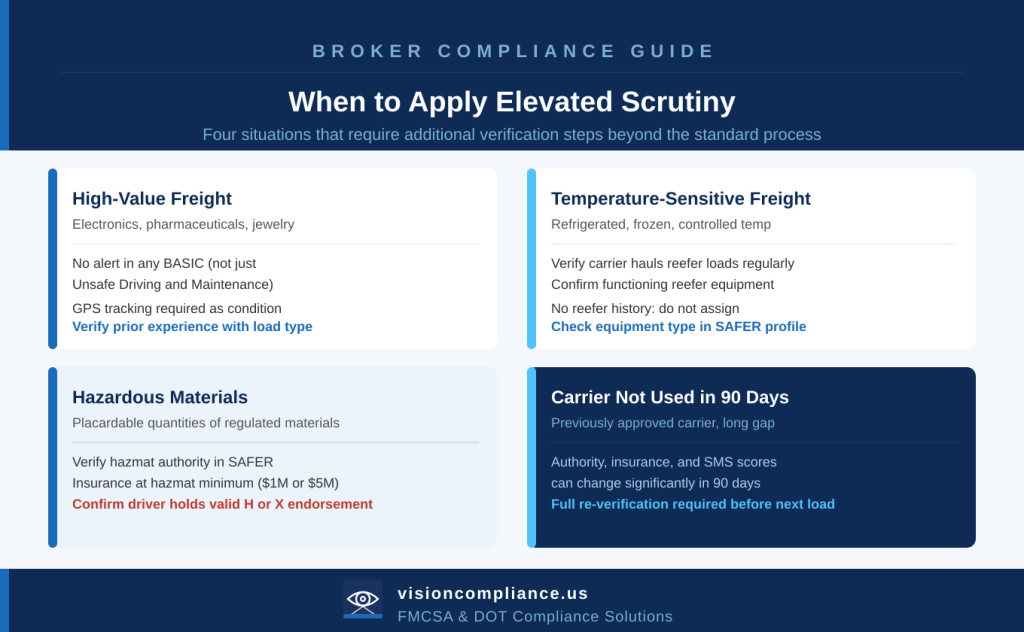
The standard 7-step process is appropriate for most carrier vetting situations. Certain load types and carrier characteristics warrant additional scrutiny beyond the standard process:
High-value freight: Electronics, pharmaceuticals, jewelry, and other high-value commodities attract cargo theft. For high-value loads, apply a no-alert standard across all BASICs rather than just Unsafe Driving and Vehicle Maintenance. Require GPS tracking as a condition of load acceptance. Consider requiring the carrier to have hauled similar freight previously.
Temperature-sensitive freight: Refrigerated loads require carriers with functioning reefer equipment and experience with temperature-controlled freight. Verify the carrier hauls refrigerated loads regularly before assigning a temperature-sensitive load to a carrier with no reefer history.
Hazardous materials: Verify the carrier has hazmat authority registered in the FMCSA system. Verify insurance at the appropriate hazmat minimum ($1,000,000 for most HM, $5,000,000 for Appendix A). Verify the assigned driver holds a current HazMat endorsement on their CDL.
Carriers not used in 90 or more days: A carrier that was vetted six months ago and has not been used since should be re-verified before the next load assignment. Authority status, insurance, and SMS scores can change significantly in 90 days.
