
A detailed breakdown of Satisfactory, Conditional, and Unsatisfactory safety ratings, what triggers them, what they cost you, and how to respond before the consequences compound
Your FMCSA safety rating is one of the most consequential numbers in your operation — and one of the least understood. It’s not the same as your SMS score. It’s not a percentile. It’s not generated automatically by a computer. It’s a formal determination made by a federal compliance investigator after reviewing your operation firsthand, and it carries consequences that can reach well beyond a fine or a follow-up audit.
Most carriers know that Unsatisfactory is bad. But few understand exactly what the rating system measures, what the difference between Satisfactory and Conditional actually means in practice, or what happens when a rating changes. This guide covers all of it — in plain language, without shortcuts.
What Is an FMCSA Safety Rating?
An FMCSA safety rating is a formal assessment of a motor carrier’s safety fitness issued following a compliance review or investigation. Unlike SMS scores — which are generated continuously from inspection and crash data — a safety rating is only assigned after a compliance investigator has reviewed the carrier’s records, operations, and management practices in person or through documentation.
The rating system is governed by 49 CFR Part 385 and uses three possible outcomes:
Satisfactory: The carrier has adequate safety management controls in place. Operations may continue without restriction.
Conditional: The carrier has deficiencies in safety management controls that could result in serious violations. Operations may continue but the carrier is on notice that corrective action is required.
Unsatisfactory: The carrier does not have adequate safety management controls in place. This is a serious finding that, if not corrected within the compliance deadline, results in an order to cease interstate operations.
There is also a fourth status — Unrated — which applies to carriers that have not yet been through a compliance review. New carriers typically begin as Unrated. Being Unrated is not the same as having a good rating; it simply means no formal review has occurred.
Where to find your rating
Your current safety rating is listed in the FMCSA’s Safety and Fitness Electronic Records (SAFER) system at safer.fmcsa.dot.gov. It is publicly visible and is one of the first things brokers, shippers, and insurers check when vetting a carrier.
How Safety Ratings Are Assigned
Safety ratings are assigned during compliance reviews — formal investigations conducted by FMCSA safety investigators or authorized state personnel. There are several types of compliance reviews, and each can result in a rating:
Comprehensive (onsite) review: A full evaluation of all six safety fitness standard factors. This is the most thorough type and is typically triggered by a poor SMS score, a pattern of violations, a serious crash, or a complaint.
Focused (onsite) review: An evaluation of specific BASIC categories where a carrier has elevated SMS scores. Narrower in scope but can still result in a rating change.
Offsite review: Conducted remotely using records submitted by the carrier. Typically triggered by violations found in roadside inspections or crashes.
During a comprehensive review, investigators evaluate the carrier against six safety fitness standard factors: general (management controls), driver, operational, vehicle, hazardous materials (if applicable), and accident. Each factor is assessed against federal regulations. Deficiencies in each factor are counted and weighted, and the aggregate determines the final rating.
Key distinction
A safety rating is not the same as an SMS alert status. You can have a Satisfactory rating and still be in SMS alert status if recent roadside inspection data has driven your BASIC percentiles above intervention thresholds. Conversely, a carrier with no formal rating (Unrated) may have excellent SMS scores. The two systems serve different purposes and operate independently.
The Three Ratings in Detail

What Happens After an Unsatisfactory Rating
An Unsatisfactory safety rating is the most serious outcome of a compliance review, and the response timeline is tight. Here is exactly what happens after an Unsatisfactory rating is issued:
Notice of proposed rating: The FMCSA issues a notice of proposed Unsatisfactory rating. At this point, the rating is not yet final.
Correction period: The carrier has 45 days (freight carriers) or 26 days (carriers of passengers or hazardous materials in certain quantities) to correct the identified deficiencies and submit documentation to the FMCSA.
Request for change in safety rating: The carrier may formally request a change in safety rating by submitting evidence of corrective action. The FMCSA will review the submission and determine whether the deficiencies have been adequately addressed.
Final rating and order: If the carrier fails to correct the deficiencies within the correction period, the Unsatisfactory rating becomes final and the FMCSA issues an order prohibiting the carrier from operating in interstate commerce.
An order to cease operations is not theoretical. It means the carrier cannot legally dispatch a truck across state lines. Violating an operations order can result in civil penalties of up to $16,000 per day per violation, as well as criminal prosecution in serious cases.
Critical timeline
45 days sounds like a long time — it isn’t. Building a credible corrective action plan, implementing changes across your operation, and documenting everything for FMCSA review requires immediate, organized action from the moment the proposed rating notice arrives. Many carriers wait too long and run out of time.
How to Respond to a Conditional Rating
A Conditional rating is a warning, not a final penalty — but it must be treated with urgency. Unlike an Unsatisfactory rating, there is no formal correction deadline attached to a Conditional rating. However, that lack of a hard deadline creates a dangerous complacency: carriers that ignore a Conditional rating and continue to accumulate violations are likely to see a compliance review resulting in an Unsatisfactory rating.
The right response to a Conditional rating is immediate and systematic:
Read the compliance review report carefully. The investigators who conducted the review documented exactly which regulations were violated and in which factor areas. This is your roadmap for corrective action.
Prioritize the highest-severity deficiencies. Not all violations carry the same weight in the rating determination. Focus first on the factors where the most critical violations were found — driver, vehicle, and operational factors tend to carry the most weight.
Document your corrective actions. Even though a Conditional rating doesn’t have a formal submission deadline, building a documented corrective action plan protects you in the event of a follow-up review. It demonstrates good-faith effort and proactive management.
Request a follow-up review if appropriate. If you’ve made substantial improvements, you can request a follow-up compliance review to have your rating reassessed. A carrier that moves from Conditional to Satisfactory has both the commercial benefit of the improved rating and the regulatory benefit of demonstrating responsiveness.
Safety Ratings and Your Business
The operational and commercial consequences of a non-Satisfactory safety rating extend well beyond the immediate regulatory response.
Broker and shipper vetting: Most large freight brokers and shippers screen carrier safety ratings before tendering loads. A Conditional rating raises concern. An Unsatisfactory rating typically results in automatic disqualification from their carrier pools — even if your operating authority has not been suspended.
Insurance: Insurance underwriters use safety ratings as a primary risk indicator. A Conditional rating can result in premium increases, coverage restrictions, or difficulty renewing policies. An Unsatisfactory rating can make obtaining or retaining commercial trucking insurance extremely difficult.
Owner-operator and driver recruitment: Experienced drivers and owner-operators are increasingly sophisticated about the carriers they work with. A poor safety rating can make it harder to attract and retain quality drivers — and quality drivers are the single most important factor in maintaining a good rating.
Contract eligibility: Many government contracts and large shipper agreements explicitly require a Satisfactory safety rating as a condition of participation. A Conditional or Unsatisfactory rating can make a carrier ineligible for significant commercial opportunities without ever triggering a formal FMCSA action.
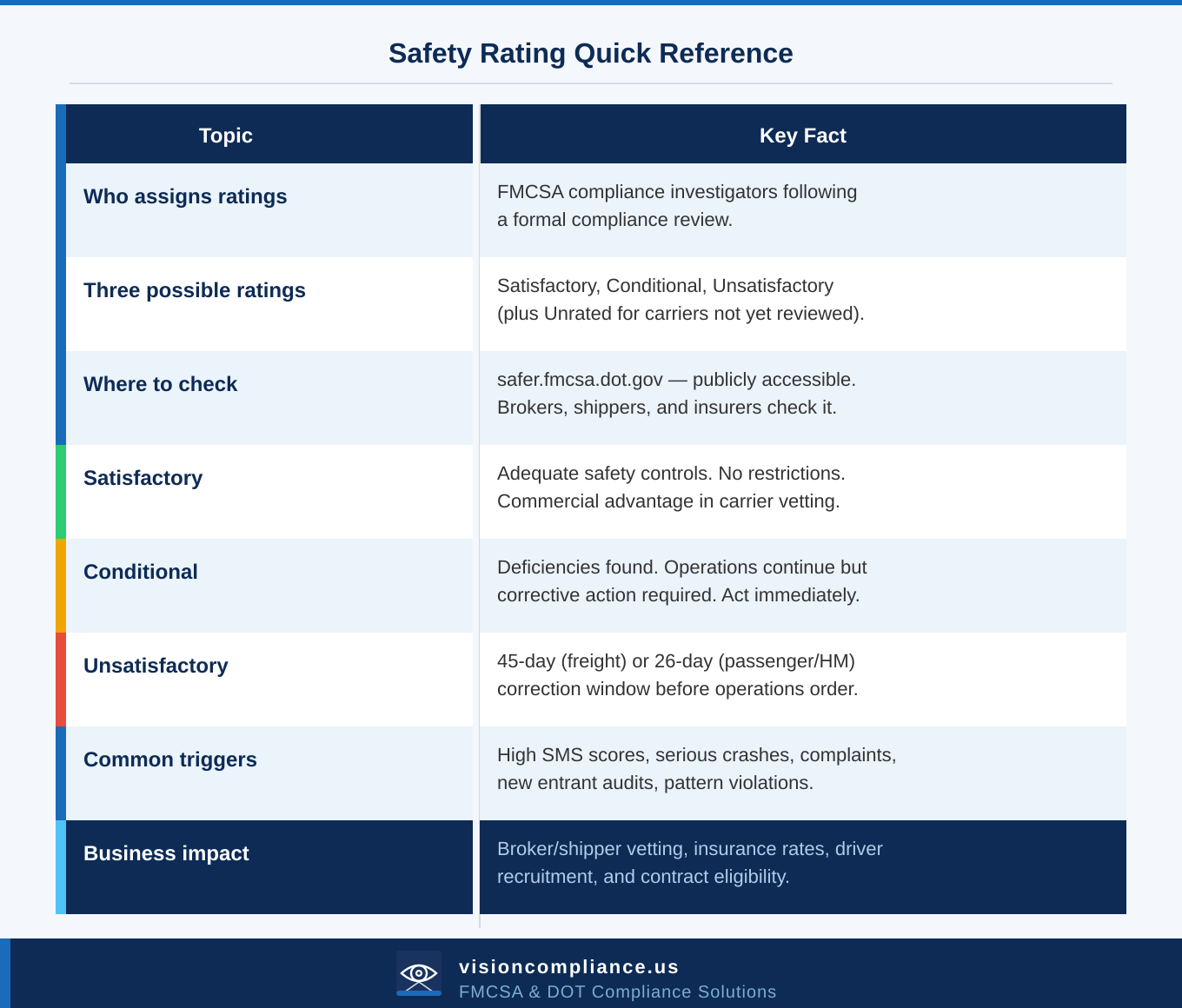
Safety Rating Quick Reference
Schedule your initial meeting to learn how we can support
