

A practical guide to building a federally compliant drug and alcohol testing program, from the required test types and minimum rates to post-accident procedures and common mistakes that expose carriers to serious liability.
Most carriers have a drug and alcohol testing program. Far fewer have one that actually works.
The distinction matters more than it sounds. A program that checks the right boxes on paper but has gaps in execution — a missed pre-employment test, a post-accident test administered 36 hours after the accident, random testing rates that run below the federal minimum — isn’t protecting the carrier. It’s creating liability while giving the appearance of compliance.
This guide walks through every component of a federally compliant drug and alcohol testing program under 49 CFR Part 382 and Part 40. More importantly, it explains the common execution failures that turn a technically adequate program into a significant risk — and how to fix them before an auditor or a plaintiff attorney finds them first.
The Regulatory Foundation: 49 CFR Parts 382 and 40
Drug and alcohol testing requirements for commercial motor vehicle drivers are governed by two federal regulations:
49 CFR Part 382: The FMCSA’s specific requirements for controlled substances and alcohol testing of CDL holders operating commercial motor vehicles. Part 382 defines who must be tested, under what circumstances, and what happens when a test comes back positive.
49 CFR Part 40: The DOT’s procedures for transportation workplace drug and alcohol testing programs. Part 40 governs how testing is conducted — collection procedures, laboratory standards, Medical Review Officer (MRO) requirements, and return-to-duty processes. It applies across all DOT-regulated industries, not just trucking.
Every carrier that employs CDL holders operating vehicles requiring a CDL in interstate commerce must have a compliant program. There are no exceptions based on fleet size. A carrier with two trucks and two drivers has the same program requirements as a carrier with two hundred.
| Who is covered: The testing requirements apply to every full-time, part-time, occasional, and casual driver who operates a CMV requiring a CDL, including owner-operators under a carrier’s operating authority. Leased drivers and owner-operators who are contracted to your operation must be in your testing program or covered by their own DOT-compliant program — and you must verify which. |
The Six Required Test Types
A compliant drug and alcohol testing program must include six distinct test types. Each has specific triggering conditions and documentation requirements. Missing any one of them — even for a single driver — is a violation.
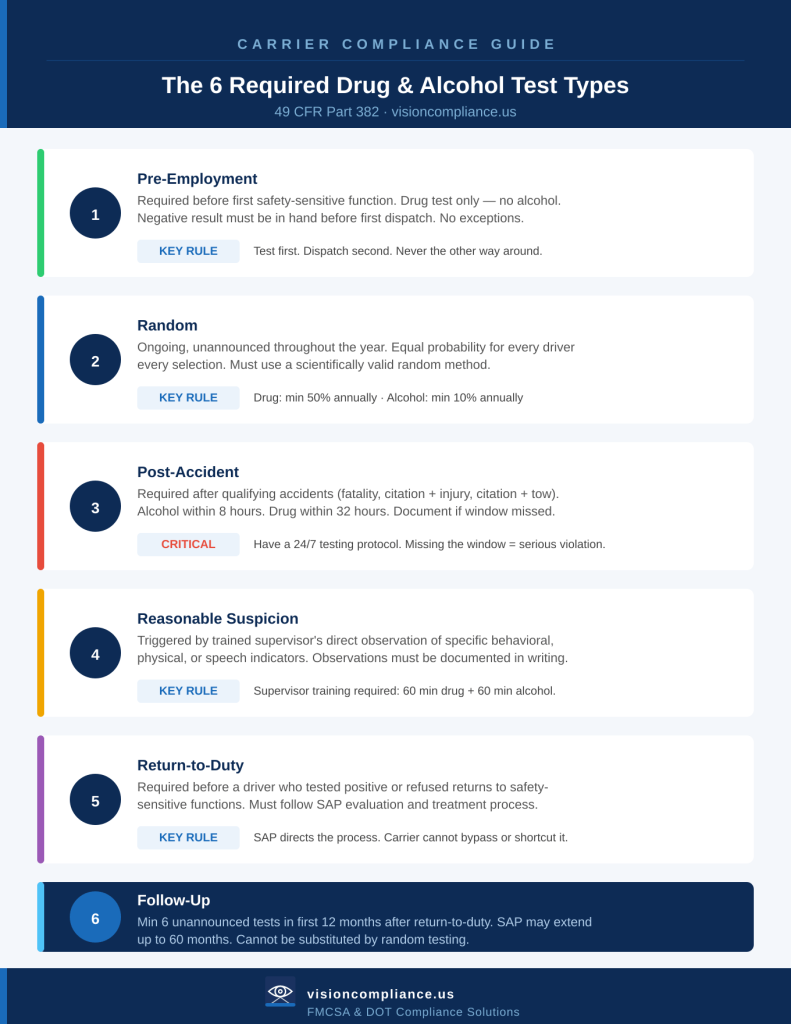
Pre-Employment Testing: The Most Common Failure Point
Pre-employment testing is where most carriers’ programs first break down — not because the test isn’t conducted, but because the sequencing is wrong.
The federal rule is unambiguous: a driver cannot perform safety-sensitive functions until the carrier has received a verified negative drug test result. This means the test must be completed and the result must be in hand before the driver’s first dispatch. A driver who picks up a load while their pre-employment test is pending is operating illegally — and the carrier is liable.
The most common pre-employment failure: dispatching a new driver the same day they complete the test collection, before the laboratory has processed the specimen and the MRO has verified the result. Processing typically takes 24-48 hours for a negative result. Some carriers address this by having drivers complete testing 2-3 days before their start date, and holding the start date until the negative result is confirmed.
Previous employer records: Under 49 CFR 391.23, carriers must query the previous DOT-regulated employers from the past three years for any drug or alcohol violations. This includes checking the FMCSA Drug and Alcohol Clearinghouse. A driver who had a verified positive test or refusal with a previous employer cannot drive until they have completed the SAP return-to-duty process.
| FMCSA Drug and Alcohol Clearinghouse Since January 2020, carriers are required to query the FMCSA Drug and Alcohol Clearinghouse before hiring any CDL holder and annually for every current driver. The Clearinghouse contains records of positive tests, refusals, and return-to-duty status for drivers subject to DOT testing. Failure to query is a violation — even if the driver has no violations in the database. |
Random Testing: Getting the Rate and the Process Right
Random testing is the backbone of any drug and alcohol program — and the area where execution failures are most common and most consequential.
The rate requirement: The FMCSA sets minimum annual random testing rates based on the industry’s overall violation rate. As of 2026, the minimum rates are 50% for controlled substances and 10% for alcohol. This means that over the course of a year, the number of random drug tests conducted must equal at least 50% of the carrier’s average driver count, and alcohol tests must equal at least 10%.
True randomness: Random selection must give every driver an equal probability of being selected at each draw. A carrier that never selects the same driver twice in a row, or that exempts certain drivers from selection, or that uses a predictable schedule, does not have a compliant random testing program. Random selection must be conducted using a scientifically valid method — most carriers use a third-party consortium that handles selection.
Notification and completion: When a driver is selected for random testing, they must be notified immediately and proceed to the collection site as soon as possible. A driver who is notified and then delays or fails to report within the required timeframe is treated as a refusal — which carries the same consequences as a positive test.
The consortium option: Most small and mid-size carriers join a drug and alcohol testing consortium, which pools their drivers with other carriers for random selection purposes. This ensures true randomness and typically manages the selection process, notification, and rate tracking. Verify that your consortium is actively managing your program — not just charging a fee.
Post-Accident Testing: The 8-Hour and 32-Hour Rules
Post-accident testing is the area where carriers most frequently miss the requirement entirely or fail to meet the timing deadline — often because the accident happens at night, on a weekend, or in a remote location.
Qualifying accidents: Not every accident triggers the testing requirement.
The test is required when:
(1) the accident involves a fatality — always;
(2) the driver receives a citation AND a person suffers bodily injury requiring immediate medical treatment away from the scene;
(3) the driver receives a citation AND a vehicle must be towed from the scene.
The alcohol window — 8 hours: Alcohol testing must be completed within 8 hours of the accident. If it cannot be completed within 2 hours, the carrier must document why. If it cannot be completed within 8 hours, testing must stop and the carrier must document the attempts made and the reasons for failure.
The drug window — 32 hours: Drug testing must be completed within 32 hours of the accident. If not completed within this window, the carrier must document why the test was not performed. The driver cannot be tested after 32 hours and the incident is treated as untested — which creates its own compliance exposure.
Preserving the driver: The driver must not consume alcohol for at least 8 hours following an accident or until they have been tested, whichever comes first. The carrier must instruct the driver of this requirement and document that they did so.
| 24/7 testing protocol The most common post-accident failure happens at night or on weekends — when the accident occurs outside of business hours and dispatch can’t quickly locate a collection site. Every carrier should have a documented post-accident testing protocol with a 24/7 collection site contact, a supervisor responsible for initiating the test regardless of time of day, and a written instruction card for drivers to carry. |
Reasonable Suspicion Testing: The Training Requirement
Reasonable suspicion testing is the only test type that requires supervisor judgment rather than a systematic trigger. And because it depends on human observation and decision-making, it’s where programs most often fail when they’re needed most.
The supervisor training requirement: Every supervisor who is responsible for determining whether a driver should be tested for reasonable suspicion must complete a minimum of 60 minutes of training on alcohol misuse and 60 minutes on controlled substance use. This training must cover the physical, behavioral, speech, and performance indicators of probable alcohol misuse and use of controlled substances.
What triggers the test: The supervisor must directly observe specific, contemporaneous, articulable observations. This means: the supervisor personally saw the behavior (not heard about it from someone else); the observation was made at the time it occurred (not hours later from memory); and the supervisor can specifically describe what they saw, heard, or smelled. A gut feeling is not sufficient. Specific observed behaviors are.
Documentation is essential: The supervisor must document the observations in writing before the driver undergoes testing or as soon as practicable after. This documentation protects the carrier if the test result is challenged and demonstrates that the testing decision was based on objective observations, not personal bias.
The Written Policy Requirement
Every carrier must have a written drug and alcohol policy that is distributed to every covered driver. This is not optional, and having a policy on file without distributing it to drivers is not compliant.
At minimum, the written policy must include:
• The identity of the person designated to answer driver questions about the policy
• The categories of drivers subject to testing
• The circumstances under which a driver will be tested
• The procedure for testing
• The requirement that drivers submit to testing
• An explanation of what constitutes a refusal to test and its consequences
• The consequences of a verified positive test result
• Information about the EAP (Employee Assistance Program) resources available
Drivers must receive the policy before their first assignment to safety-sensitive functions. The carrier must document that each driver received and reviewed the policy — typically through a signed acknowledgment form retained in the driver’s qualification file.
Recordkeeping: What You Must Keep and for How Long
Drug and alcohol testing records must be retained for specific periods depending on the record type. Failure to maintain these records is itself a violation — and missing records are treated as missing compliance in a DOT audit.
5 years: Alcohol test results with a concentration of 0.02 or greater; verified positive drug test results; refusals to test; driver evaluations and referrals; calibration documentation.
2 years: Records related to the collection process; negative and cancelled drug test results; alcohol tests below 0.02.
1 year: Negative pre-employment drug test results.
Indefinitely: Written policies; annual program summaries.
Records must be stored in a secure location with controlled access. They may be kept in electronic format provided they are accessible and reproducible. Third-party administrators (TPAs) often maintain records on behalf of carriers — verify that your TPA’s retention practices meet federal requirements and that you can obtain records when needed.
Building a Program That Actually Protects You
The difference between a program that exists on paper and one that actually protects the carrier comes down to four things: ownership, documentation, consistency, and verification.
Assign a Designated Employer Representative (DER). Every program needs one person who is accountable for its execution — who knows the requirements, manages the consortium relationship, tracks random testing completion, initiates post-accident testing, and maintains records. Without clear ownership, programs drift toward non-compliance.
Document every decision and every test. The test result alone is not enough. Document the date the driver was notified, who notified them, where they were tested, and when the result was received. For post-accident tests, document the time of the accident, the time testing was initiated, and any delays and their reasons.
Audit your program annually. At the end of each calendar year, review your program for: actual random testing rates against the required minimums; documentation completeness for every pre-employment test; post-accident testing completion and timing; Clearinghouse query compliance; and policy acknowledgment records for every active driver.
Verify your service providers. Your testing consortium, collection sites, MRO, and SAP are all part of your program. Their compliance failures become your compliance failures. Verify annually that your consortium is using certified laboratories, that your collection sites are properly qualified, and that your MRO is certified.